“Give us
bread and roses.” This is the slogan of International Women’s Day. The rose
symbolizes the right to participate in politics. On Coming-of-Age Day as well,
women are often given roses and perfume as gifts. It invites us to reflect on
what it truly means to become an adult woman. In a book written by Celia
Lyttelton, the author explains, “Even in a Turkish book from the early 18th
century, the rose is described as the flower with the richest language. It is a
flower capable of expressing every emotion, from desire and love to affection,
interest, and purity.” Since the
beginning of human history, the rose has been one of the most beloved flowers
and has long been treasured as a source of fragrance. The Persians perfected
the technique of distilling roses, and records from the Roman era show that
people loved the scent of roses so much that they created rose-water fountains
and even sprinkled rose essence on food. Today,
roses are classified into more than 10,000 varieties, each possessing its own
subtle fragrance differences. Moreover, when blended with ingredients such as
sandalwood, neroli, and patchouli, the rose transforms into an endlessly
versatile and multifaceted ingredient. For this reason, even renowned perfumers
often admit that creating a fragrance centered on the rose, or approaching it
from a new perspective, requires great effort. Nevertheless,
perfumes containing the scent of roses continue to be launched and loved by
people around the world because of the romantic symbolism that roses embody
(Hyangjang, No. 619).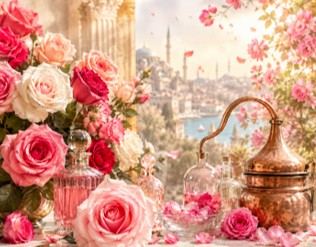
|